Posted by Joshua Gardner on | Comments Off on Understanding the Different Types of Military Radios
Understanding the Different Types of Military Radios
There are several sectors where reliance on the use of radio products is essential for basic operations, and the military world is a top example. What kinds of radios does the military use? There are a few key varieties to be aware of.
At Amphenol NEXUS Technologies, we’re proud to serve as a leader in advanced telecommunications manufacturing, offering a huge selection of rangers, TAC connectors, plugs, jacks and numerous others for various applications. Military entities are among our top clients, and we offer a wide variety of Mil-Spec and Mil-Spec-Type products. Here’s a breakdown on the types of radios used by the military today, plus some of their basic qualities.
AN/PRC-163
The AN/PRC-163 is a dual-channel tactical handheld radio manufactured by L3Harris, a leader in military technology. Often referred to in military circles as the Leader Radio, it has several modes:
VHF/UHF Line-of-Sight (VULOS)
SINCGARS
Soldier Radio Waveform
Tactical Scalable MANET
P25
Mobile User Objective System satellite communication mode
The dual-channel method allows personnel to simultaneously monitor two different networks, providing increased situational awareness and communication capabilities. Its compact size and durability make it a preferred choice for dismounted troops.
At Amphenol NEXUS Technologies, we offer MIL-DTL-55116 (likely) connector standards for use with the AN/PRC-163. This option includes inline headset and remote mic connections.
AN/PRC-77
Also known as the AN/PRC 77 Radio Set, this product is a portable VHF FM combat-net radio transceiver manufactured by Associated Industries. Its primary purpose is to offer short-range, two-way radio voice communications.
This is one of the military’s oldest and most reliable radio products, first used in 1968 during the Vietnam War and upgraded several times since. While many uses of the AN/PRC-77 have been replaced by SINCGARS radios, modern uses like secure voice transmission, full encryption and more are still valuable and it remains in use in some sectors of the military.
At Amphenol NEXUS Technologies, we offer several products with MIL-DTL-55116 U-229 connector standards for the AN/PRC 77 Radio Set, with headset and handset inline cable options.
AN/PRC Tactical
There are also several different AN/PRC tactical radio options produced by L3Harris and similar entities. The AN/PRC-152A Wideband Networking Handheld Radio, for instance, provides simultaneous voice, video and high-speed data in a highly portable form factor.
Another great example is the AN/PRC-148 MBITR/JEM from Thales, which is one of the smallest and lightest tactical handheld radios on the market. Options like these offer incredible power efficiency, often a must for military needs.
At Amphenol NEXUS Technologies, we offer MIL-DTL-55116 and Ranger connector standards for these various tactical radios. Our audio, headset and other comm console interfaces are ideal for many military needs.
Civil/Military Headsets
We also proudly provide several products for civil and military headsets under the MIL-DTL-55116 network and other variants. These products feature rugged and durable designs, as well as high-quality audio transmission for clear communication. Our headsets are designed to withstand harsh environments and provide reliable communication for critical operations.
So for all your connector needs for military radios and related products, contact our team at Amphenol NEXUS Technologies today!
Posted by Joshua Gardner on | Comments Off on Determining Microphone Jack Size
The selection of proper microphone jack size stands as a fundamental requirement in audio and communication system development to maintain system reliability and compatibility. Our microphone connector experts at Amphenol NEXUS Technologies help explain how jack selection affects electrical integrity and mechanical fit which directly impacts system reliability and how the correct selection of microphone jack dimensions together with pin configurations becomes crucial when you want to integrate a microphone.
In our guide, we explain different microphone jack types together with their main applications and selection criteria according to project specifications.
Common Microphone Jack Types
3.5 mm Mini Jack (1/8″)
Audio systems use the 3.5 mm mini jack microphone as one of their primary interface standards for modern applications. This connector appears on multiple devices including portable recorders, laptops, cameras and communication headsets. This connector supports TRS (Tip-Ring-Sleeve) and TRRS (Tip-Ring-Ring-Sleeve) pinouts because the microphone functions for either stereo audio or mono input or inline control signal paths.
his jack is commonly paired with:
Compact wired headsets
Lavalier microphones for portable use
Digital voice recorders
Microphones designed for smartphones or tablets
hanks to its small size and broad compatibility, the 3.5 mm format is a practical solution for systems that prioritize space savings without compromising basic audio functionality.
6.35 mm Jack (1/4″)
he 6.35 mm jack, also referred to as the 1/4-inch jack, is most often found in professional and industrial audio setups. This format is valued for its durability, mechanical stability, and higher current-handling capabilities. In most applications, it is used with mono or stereo microphones, often in TRS configuration.
ypical use cases include:
Instrument and studio microphones
Mixing consoles and rack-mounted gear
High-durability headset systems in harsh environments
Signal interfaces in legacy or analog broadcast hardware
Due to its size, the 6.35 mm jack is best suited for fixed installations or equipment requiring high connection integrity and repeated plug cycles.
2.5 mm Subminiature Jack
Although less common in newer systems, the 2.5 mm jack remains in use for specialized communication hardware and compact devices. Its small footprint is ideal for handheld transceivers, radio communication headsets, or legacy electronics with minimal space.
Application examples:
wo-way radios and walkie-talkies
Older camcorder microphones
Lightweight aviation and tactical headsets
When used in the correct environment, this connector format provides reliable audio signal delivery without adding excess bulk.
Choosing the Right Jack for Your Application
When evaluating what size microphone jack do I need, consider the following:
Device compatibility: Review input specifications and signal requirements.
Mechanical design: Determine available space and required retention strength.
Environmental factors: Choose a size appropriate for mobile or ruggedized conditions.
Signal configuration – Match the jack format to the microphone’s wiring and application.
Failure to select the correct jack can result in signal loss, connector failure, or the need for adapters that introduce unwanted resistance or noise.
Supporting Precision in Audio Design
In audio and communications design, interface reliability matters just as much as signal clarity. Whether you’re working with compact digital headsets, studio equipment, or field-deployed communication systems, choosing the right microphone jack type is essential for system performance and longevity. Our high-performance audio connectors at Amphenol NEXUS Technologies serve mission-critical applications for professionals in defense, aerospace and industrial sectors.
Contact us today and speak to our Amphenol NEXUS Technologies specialists available to discuss microphone jack compatibility and connector solutions for your next upcoming system build.
Posted by Greg Diblasi on | Comments Off on How to Select a Switch for Military Applications
How to Select a Switch for Military Applications
The military industry relies on push-button switches for a variety of mission-critical applications, including naval systems, aircraft, ground vehicles, avionics, command systems, and more. Not only do these switches have ergonomic and technical specifications to ensure reliability and high performance, but they must also meet strict military standards. To help you determine the right switch for your military application, this blog will go over the various standards they must meet.
What Does MIL-SPEC or MIL-STD Mean?
MIL-SPEC or MIL-STD is a military and defense manufacturing standardization set forth by the U.S. Department of Defense for any product used in military applications. More specifically, these specifications define the physical characterizations of products as well as the processes and materials used to create them. For example:
MIL-STD-1472 outlines product design rules
MIL-STD-810 and 202 define environmental test conditions
MIL-STD-461 specifies EMC test conditions
The MIL-SPEC or MIL-STD standardization ensures products made for military applications adhere to a required manufacturing and certification process. Meeting these criteria not only results in better performance and durability but also creates a stronger guarantee of safety and reliability.
Which Standards Apply to Military Switches?
In addition to those mentioned above, there are several other standards that military switches must adhere to, each of which precisely outlines manufacturing guidelines for qualification tests, product specifications, marking, and more. Three MIL standards that are specifically dedicated to military switches include:
MIL-STD-3950: Defines the requirements for environmentally sealed toggle switches
MIL-STD-83731: Outlines the general specifications for sealed and unsealed toggle switches
MIL-S-8805/3: Defines the requirements for sealed snap action sensitive push-button switches
In addition to MIL standards, there are other standards and certifications that apply to military switches, including:
QPL (Qualified Part List) listed. If a military switch is QPL listed, it means it has been qualified and validated by the Defense Logistics Agency (DLA), a U.S. government agency of the Department of Defense.
CECC 96000. This is a European quality standard that specifies testing rules for military switches. More specifically, CECC 96201-008, 96201-005, and 96401-001 outline the tests required by the military industry.
How to Select Your Mil-Spec Push-Button Switch
When choosing the best push-button switch for your military application, it is important to partner with a manufacturer of MIL and CECC qualified products. By working with a manufacturer that is well-versed in military specifications, standards, and constraints, you’ll gain access to:
Products that meet military specifications. Depending on your specific application, you may need switches that fit certain criteria. A provider of military-compliant switches can help you find a switch that meets your needs for electromagnetic immunity, extreme temperature resistance, shock and vibration resistance, sealing (rated to IP67 or IP68), and more.
Quality assurance. Manufacturers of MIL-SPEC push-button switches must maintain a strict quality management system to ensure performance and safety.
Products that are 100% tested. Military-compliant switches undergo rigorous testing to ensure they meet requirements for ergonomics, performance, and reliability.
MIL-SPEC Push-Button Switches From Amphenol Nexus Technologies
Military equipment relies on rugged, reliable switches to ensure the success of missions. When choosing a switch for military applications, it is important to consider the environment in which the switch will be used as well as the application’s specific requirements. Various switches are available to meet the needs of military applications, so it is important to work with a qualified supplier to find the best solution for your needs.
At Amphenol Nexus Technologies, we offer a wide variety of MIL-SPEC push-button switches designed to meet demanding military requirements. To learn more about our products, or for help determining the best switch for your application, contact us or request a quote today.
Posted by Greg Diblasi on | Comments Off on What Are Tactile Switches?
Tactile switches are electromechanical switches installed beneath the keys of a computer keyboard, motor control keyboard, keypad, and other electronic devices. They produce the satisfying “bump” that users feel in their fingers when they strike a key, coupled with a distinct clicking sound. These tactile and auditory cues inform a user that a key or keyboard is functioning as it should and is registering the applied actuation force during typing. Learn more about the components that make up a tactile switch, why they are useful, and their advantageous characteristics.
Click to Expand
Tactile Switch Components
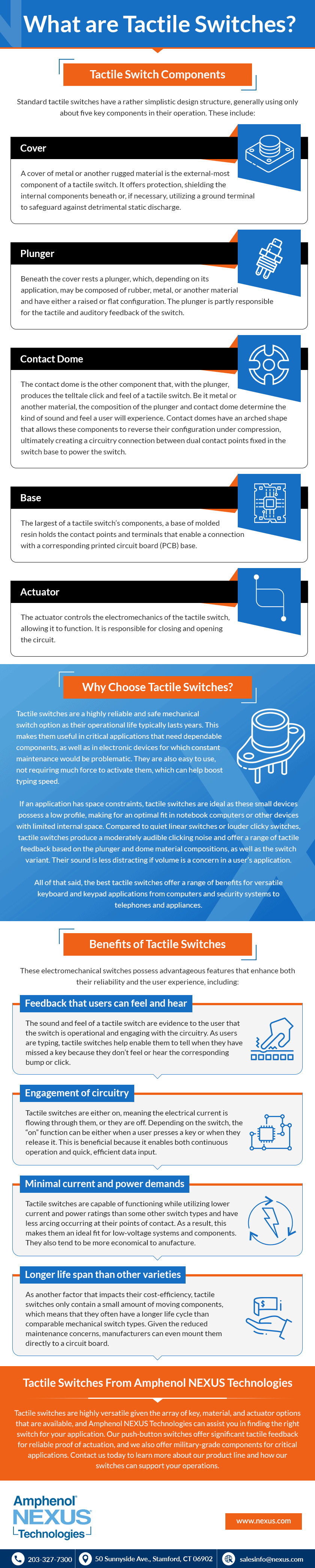
Standard tactile switches have a rather simplistic design structure, generally using only about five key components in their operation. These include:
Cover. A cover of metal or another rugged material is the external-most component of a tactile switch. It offers protection, shielding the internal components beneath or, if necessary, utilizing a ground terminal to safeguard against detrimental static discharge.
Plunger. Beneath the cover rests a plunger, which, depending on its application, may be composed of rubber, metal, or another material and have either a raised or flat configuration. The plunger is partly responsible for the tactile and auditory feedback of the switch.
Contact dome. The contact dome is the other component that, with the plunger, produces the telltale click and feel of a tactile switch. Be it metal or another material, the composition of the plunger and contact dome determine the kind of sound and feel a user will experience. Contact domes have an arched shape that allows these components to reverse their configuration under compression, ultimately creating a circuitry connection between dual contact points fixed in the switch base to power the switch.
Base. The largest of a tactile switch’s components, a base of molded resin holds the contact points and terminals that enable a connection with a corresponding printed circuit board (PCB) base.
Actuator. The actuator controls the electromechanics of the tactile switch, allowing it to function. It is responsible for closing and opening the circuit.
Why Choose Tactile Switches?
Tactile switches are a highly reliable and safe mechanical switch option as their operational life typically lasts years. This makes them useful in critical applications that need dependable components, as well as in electronic devices for which constant maintenance would be problematic. They are also easy to use, not requiring much force to activate them, which can help boost typing speed.
If an application has space constraints, tactile switches are ideal as these small devices possess a low profile, making for an optimal fit in notebook computers or other devices with limited internal space. Compared to quiet linear switches or louder clicky switches, tactile switches produce a moderately audible clicking noise and offer a range of tactile feedback based on the plunger and dome material compositions, as well as the switch variant. Their sound is less distracting if volume is a concern in a user’s application.
All of that said, the best tactile switches offer a range of benefits for versatile keyboard and keypad applications from computers and security systems to telephones and appliances.
Benefits of Tactile Switches
These electromechanical switches possess advantageous features that enhance both their reliability and the user experience, including:
Feedback that users can feel and hear. The sound and feel of a tactile switch are evidence to the user that the switch is operational and engaging with the circuitry. As users are typing, tactile switches help enable them to tell when they have missed a key because they don’t feel or hear the corresponding bump or click.
Engagement of circuitry. Tactile switches are either on, meaning the electrical current is flowing through them, or they are off. Depending on the switch, the “on” function can be either when a user presses a key or when they release it. This is beneficial because it enables both continuous operation and quick, efficient data input.
Minimal current and power demands. Tactile switches are capable of functioning while utilizing lower current and power ratings than some other switch types and have less arcing occurring at their points of contact. As a result, this makes them an ideal fit for low-voltage systems and components. They also tend to be more economical to manufacture.
Longer life span than other varieties. As another factor that impacts their cost-efficiency, tactile switches only contain a small amount of moving components, which means that they often have a longer life cycle than comparable mechanical switch types. Given the reduced maintenance concerns, manufacturers can even mount them directly to a circuit board.
Tactile Switches From Amphenol NEXUS Technologies
Tactile switches are highly versatile given the array of key, material, and actuator options that are available, and Amphenol NEXUS Technologies can assist you in finding the right switch for your application. Our push-button switches offer significant tactile feedback for reliable proof of actuation, and we also offer military-grade components for critical applications. Contact us today to learn more about our product line and how our switches can support your operations.
Posted by Greg Diblasi on | Comments Off on What Are Waterproof Electrical Connectors?
Click to Expand
Water from rain, humidity, or snow can easily damage electrical wiring, potentially causing shorts and starting fires. That’s why it’s important to use waterproof electrical connectors to protect the wiring from the elements. Waterproof electrical connectors are designed to keep water out of the connection point, preventing damage and ensuring a safe and reliable connection. Here we’ll discuss how waterproof electrical connectors work as well as their specifications and ratings for various environments.
How Waterproof Connectors Work
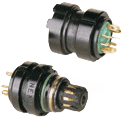
Waterproof electrical connectors are a critical component in applications where exposure to water is likely. They are commonly used in marine and outdoor settings, as well as in any indoor environment where high humidity is present. Waterproof electrical connectors form very tight seals to resist even the toughest high-moisture conditions.
This seal is possible through prongs that fit snugly around the connection points. The connectors are often coated with a waterproofing compound like rubber, which enters the receptacle end, fills in any gaps, and provides insulation against electrical shocks. As a result, waterproof electrical connectors provide a reliable and safe way to power equipment in potentially hazardous environments.
Ingress Protection (IP) Ratings
Specified by IEC standard 60529, Ingress Protection (IP) ratings are standards used to rate the level of protection against water, dust, and temperatures that an electrical enclosure offers. The ratings range from no protection to full protection against complete immersion. The higher the IP rating, the greater the protection.
When it comes to waterproof connectors, IP ratings are important to consider because they indicate how well the connector will perform in wet or dusty environments. The first number of an IP rating indicates the protection against solids like dust, while the second number indicates protection against liquids. For example, waterproof connectors are typically rated at IP68, meaning they are completely dust-tight and can withstand being immersed in water for extended periods.
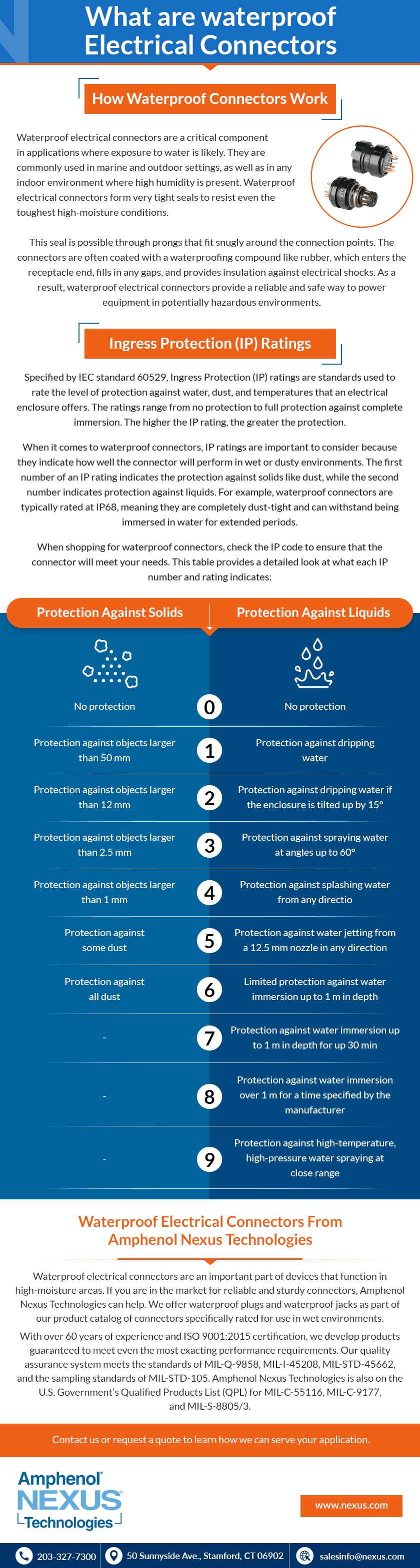
When shopping for waterproof connectors, check the IP code to ensure that the connector will meet your needs. This table provides a detailed look at what each IP number and rating indicates:
Protection against solids
Protection against liquids
0
No protection
0
No protection
1
Protection against objects larger than 50 mm
1
Protection against dripping water
2
Protection against objects larger than 12 mm
2
Protection against dripping water if the enclosure is tilted up by 15°
3
Protection against objects larger than 2.5 mm
3
Protection against spraying water at angles up to 60°
4
Protection against objects larger than 1 mm
4
Protection against splashing water from any direction
5
Protection against some dust
5
Protection against water jetting from a 12.5 mm nozzle in any direction
6
Protection against all dust
6
Limited protection against water immersion up to 1 m in depth
7
Protection against water immersion up to 1 m in depth for up 30 min
8
Protection against water immersion over 1 m for a time specified by the manufacturer
9
Protection against high-temperature, high-pressure water spraying at close range
Waterproof Electrical Connectors From Amphenol Nexus Technologies
Waterproof electrical connectors are an important part of devices that function in high-moisture areas. If you are in the market for reliable and sturdy connectors, Amphenol Nexus Technologies can help. We offer waterproof plugs and waterproof jacks as part of our product catalog of connectors specifically rated for use in wet environments.
With over 60 years of experience and ISO 9001:2015 certification, we develop products guaranteed to meet even the most exacting performance requirements. Our quality assurance system meets the standards of MIL-Q-9858, MIL-I-45208, MIL-STD-45662, and the sampling standards of MIL-STD-105. Amphenol Nexus Technologies is also on the U.S. Government’s Qualified Products List (QPL) for MIL-C-55116, MIL-C-9177, and MIL-S-8805/3. Contact us or request a quote to learn how we can serve your application.
Posted by Greg Diblasi on | Comments Off on Breaking Down Military Connector Specifications
Breaking Down Military Connector Specifications
Components for military applications must be built and tested according to specific military specifications, or Mil-Spec. Learn more about the value of Mil-Spec connectors and the Mil-Spec standards that regulate their features, performance, and testing.
What Are Mil-Spec Connectors?
Mil-Spec connectors are paired male and female components that transfer signals or electricity through contact points. Connectors have three main parts: the contacts, exterior shell, and terminals. These components must be able to withstand harsh environments. For example, the contacts are typically made of a highly conductive, noncorrosive material such as gold-plated phosphor bronze.
Mil-Spec connectors must comply with established requirements and are rated for safe and effective performance in certain military operations.
Military Connector Specifications
There are multiple Mil-Spec standards that guide the production and assessment of different types of connectors. The following standards apply to electrical connectors.
MIL-DTL-26482: This establishes the requirements for circular electrical connectors, which include quick disconnect, environmental resistance, and extreme temperature range.
MIL-DTL-55116: This describes requirements for connectors in radios and fill systems.
MIL-DTL-83527: This sets the requirements and testing criteria for highly specialized connectors meant for use in extremely rugged environments.
Amphenol Nexus Technologies offers the following Mil-Spec connectors that are compliant with the above standards.
M8805/3 switches: These push-button switches are specially rated for water submersion. They are often used in aircraft, ground vehicles, naval systems, rugged communications, and avionics.
M9177 telephone jacks and plugs: Our M9177 jacks feature a contact material of nickel-plated beryllium copper, and the plugs have a Monel contact. Both have a plastic shell. These products are ideal for ruggedized commercial and military applications.
At Amphenol Nexus Technologies, we specialize in designing and manufacturing durable Mil-Spec connectors that comply with military standards.
We offer M8805/3 switches, M9177 telephone jacks and plugs, and M55116 audio jacks and plugs. Our M55116 Mil-Spec jacks and plugs provide long-lasting connections in audio components for radios, intercom systems, and more. They can take up to 60V and a 0.5A maximum current. With either solder cup contacts or crimp sleeves, these connectors are available with miniaturization, right angle, filtering, and shielding.
If you’re ready to select a Mil-Spec connector for your application, contact us today to learn more about our manufacturing capabilities.
Posted by Greg Diblasi on | Comments Off on The Importance of Mil-Spec Connectors
The Importance of Mil-Spec Connectors
Military organizations establish strict standards for the components, equipment, and other manufactured goods they use in military operations. Those standards are referred to as Mil-Spec, or military specifications, and they establish the required dimensions, ratings, and features for each part.
What Are Mil-Spec Connectors?
Mil-Spec electrical and fiber-optic connectors, particularly the Army-Navy series, are the modern standard for military circular connectors. Their design, manufacturing, and operational capabilities must meet certain requirements for heavy-duty use in military applications. For example, mil-spec connectors consist of male and female pairs that must be constructed from noncorrosive, conductive metals such as gold-plated beryllium copper and contained in a dielectric insulator.
Manufacturers and military organizations work together to ensure a product design meets the right standards for certain environments and applications. Because these standards demand durability and reliable performance, other industries—such as aerospace, marine, and automotive—also prefer Mil-Spec connectors.
Choosing Mil-Spec Connectors
When selecting Mil-Spec connectors, ensure each part of the component complies with the applicable military standards. Consider different product options such as size, type, coupling method, and materials.
Contacts
The contacts create the electrical path that travels from one connector to its mate. Contacts are made from pins and sockets, and they can have different coupling designs to ensure a reliable connection. These designs include threaded coupling, breech lock coupling, and bayonet coupling.
Shells
The connector shell is the protective housing that holds the contact points and internal parts. Usually made of corrosion-resistant aluminum, the shell can come in different styles, such as an angled or straight plug, box-mount or wall receptacle, or dummy receptacle. Circular Mil-Spec connectors are cylindrical and vary in size.
Terminals
Terminals into the system usually have a crimped or soldered connection. The terminals attach the connector to a conductor to facilitate an electrical flow.
M55116 Mil-Spec and Mil-Spec-Type Connectors
At Amphenol Nexus Technologies, we specialize in creating Mil-Spec components and connectors, such as audio plugs and jacks. Our M55116 Mil-Spec audio connectors feature polarized plugs with multiple pins, a waterproof design, and options for added shielding, filtering, miniaturization, and right angle. They can handle frequency circuits up to 60V and a maximum current of 0.5A. Our Mil-Spec connectors are commonly used in audio systems for military radios and intercoms.
In addition to our M55116 Mil-Spec product line, we also carry M9177 telephone jacks and plugs and M8805/3 switches.
Connectors that meet or exceed Mil-Spec standards provide long-term, reliable performance. Many products on the market meet these standards, but your specific application will determine which connectors are right for you. Amphenol Nexus Technologies is committed to providing the highest quality Mil-Spec connectors that fit your needs. Contact us today to learn more about our capabilities.
Posted by Greg Diblasi on | Comments Off on What is a Breakaway Connector?
What is a Breakaway Connector?
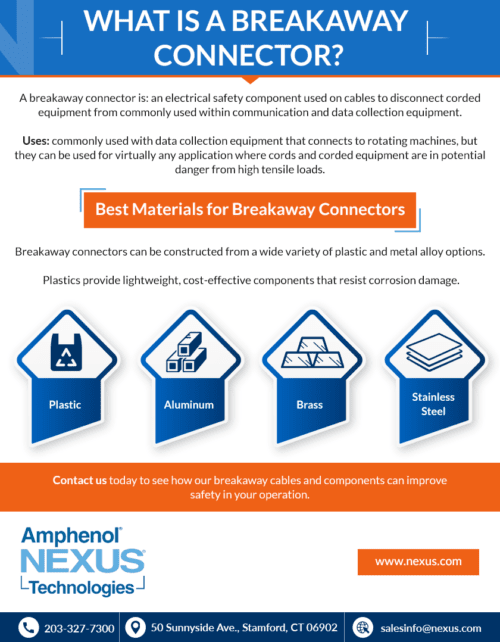
A breakaway connector is an electrical safety component used on cables to disconnect corded equipment from moving components or rotating machinery. If rotating or moving machinery starts to move while a sensor or cable is tangled within it, the breakaway connector will disconnect immediately so the corded equipment isn’t dragged into the moving equipment.
Breakaway connectors are commonly used with data collection equipment that connects to rotating machines, but they can be used for virtually any application where cords and corded equipment are in potential danger from high tensile loads. These components are also sometimes called weak links or weak fuses.
Best Materials for Breakaway Connectors
Breakaway connectors can be constructed from a wide variety of plastic and metal alloy options. Plastics provide lightweight, cost-effective components that resist corrosion damage. However, manufacturing plastic breakaway connectors does require an upfront investment to design and develop tooling for the molding process. Plastic may also wear down faster than other material options.
Metals such as aluminum offer another viable and popular choice. This material is more resistant to wear and damage than plastic, while remaining lightweight and easy to work with. However, aluminum is more vulnerable to corrosion damage than plastic. Heavier metal options include brass and stainless steel. While these options are more resistant to corrosion and physical damage, the additional weight can interfere with the effectiveness of the component.
It’s possible to enhance corrosion resistance and other properties on plastic or metal breakaway connectors through plating.
The Importance of Plating and Color for Breakaway Connectors
By plating metal or plastic breakaway connectors with thin layers of other materials, manufacturers can imbue connectors with the positive characteristics of multiple materials. Chroming aluminum components, for example, allows for the use of lightweight metal while protecting it from corrosion.
Breakaway connectors also come in different colors, and those colors communicate important attributes of the connector. For example, mating pairs of components can have the same color so technicians can easily pair the parts together. Colors may also designate brand, orientation, and material characteristics for the connectors, depending on the application.
Breakaway Connectors From Amphenol NEXUS Technologies
At Amphenol NEXUS Technologies, we specialize in manufacturing and supplying 7- and 10-pin breakaway connectors with a durable, waterproof design. We provide a wide range of standard and miniature breakaway components, plugs, and jacks for an array of applications, including:
C4I systems
Military aircraft
Commercial aircraft
Military ground vehicles
Soldier systems
Missiles and ordnance
Commercial/industrial equipment
Contact us today to see how our breakaway cables and components can improve safety in your operation.
Posted by Greg Diblasi on | Comments Off on What is a Push Button Switch?
What is a Push Button Switch?
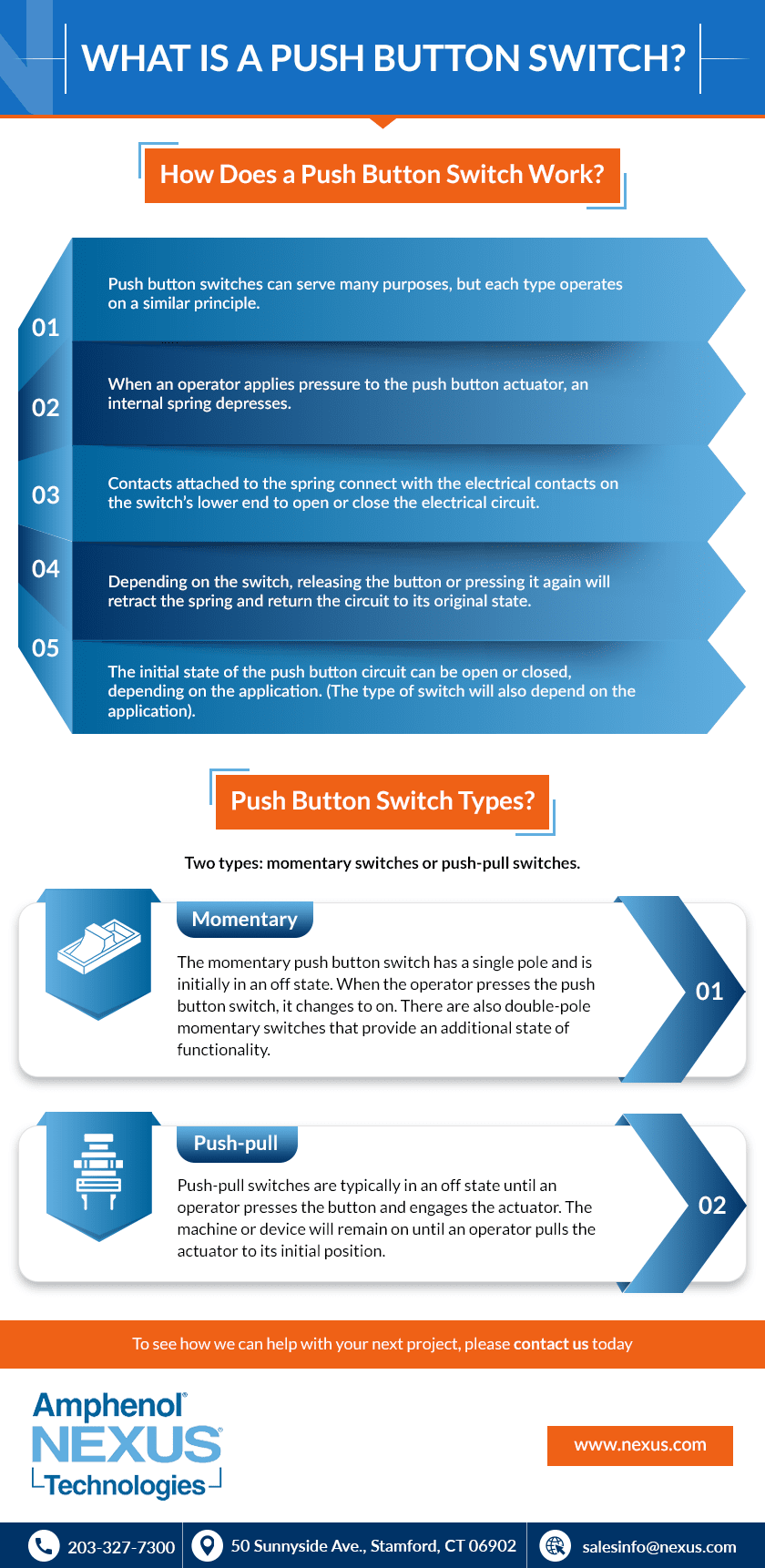
A push button switch is a simple mechanism that initiates power to a machine, device, or appliance. The body is typically metal or plastic, featuring a durable and ergonomic design. With switches available that provide latching or momentary action, there are push button switches for virtually any relevant application. This blog will explain how push button switches work and discuss typical applications for various push button switch types.
How Does a Push Button Switch Work?
Push button switches can serve many purposes, but each type operates on a similar principle. When an operator applies pressure to the push button actuator, an internal spring depresses. Contacts attached to the spring connect with the electrical contacts on the switch’s lower end to open or close the electrical circuit. Depending on the switch, releasing the button or pressing it again will retract the spring and return the circuit to its original state.
The initial state of the push button circuit can be open or closed, depending on the application. The type of switch will also depend on the application.
Push Button Switch Types
Push button switches come in two types: momentary switches or push-pull switches.
Momentary. The momentary push button switch has a single pole and is initially in an off state. When the operator presses the push button switch, it changes to on. There are also double-pole momentary switches that provide an additional state of functionality.
Push-pull. Push-pull switches are typically in an off state until an operator presses the button and engages the actuator. The machine or device will remain on until an operator pulls the actuator to its initial position.
Selecting a Push Button Switch for Military Applications
Military push button switches undergo rigorous testing and quality control. They must meet high reliability and performance requirements, in addition to ergonomic specifications. Relevant military specifications for push buttons include MIL-S-8805/3 and MS25089. Military push buttons require numerous capabilities, such as:
Electromagnetic immunity
Extreme temperature operation
Resistance to salt spray
IP67 or IP68 waterproofing
Shock and vibration resistance
Matte black chrome finish
Push Button Switches From Amphenol NEXUS Technologies
Amphenol Nexus Technologies can produce durable and tactile momentary switches and push-pull switches. Our experts have extensive experience designing and manufacturing rugged switches used in numerous commercial, industrial, marine, and military settings, such as:
Industrial machinery
Soldier systems
Command systems
Ruggedized communications systems
Naval systems
Ground vehicles
Avionics
Commercial and military aircraft
Our custom switches allow us to meet your exact specifications, and our military push button switches comply with MIL-S-8805/3 and MS25089. We also manufacture connectors that make it simple to implement our push button switches.
Posted by Greg Diblasi on | Comments Off on What is the Difference Between Microphone Plugs & Jacks?
Difference Between Microphone Plugs & Jacks
Even with the continued rise of wireless technology, many high-quality headsets, microphones, and other audio equipment still rely on wired connections to boost sound quality and functionality. How these devices plug into computers and larger pieces of equipment matters, as does the material used to make the contact points.
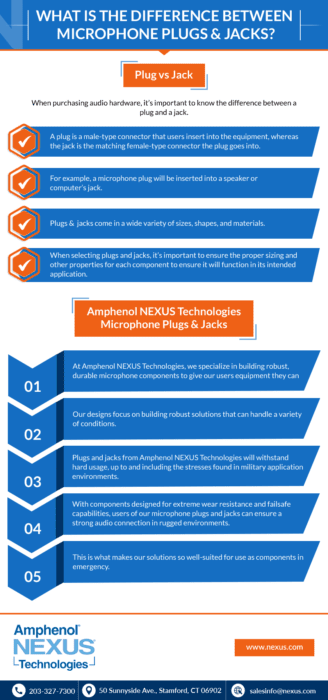
When purchasing audio hardware, it’s important to know the difference between a microphone plug and a microphone jack. A plug is a male-type connector that users insert into the equipment, whereas the jack is the matching female-type connector the plug goes into. For example, a microphone plug will be inserted into a speaker or a computer’s jack. Plugs and jacks come in a wide variety of sizes, shapes, and materials. When selecting plugs and jacks, it’s important to ensure the proper sizing and other properties for each component to ensure it will function in its intended application.
Understanding Microphone Plugs and Jacks
Microphone plugs and jacks play a critical role in wired audio systems, affecting everything from sound quality to equipment reliability. These components come in several formats, including 3.5mm, 6.35mm, and dual-pin connections. Some use TS or TRS configurations to carry mono or stereo signals.
At Amphenol NEXUS Technologies, we specialize in building durable microphone plug and microphone jack components to give our users equipment they can rely on. Our designs focus on building rugged solutions that can handle a variety of conditions.
For example, we incorporate nylon into our microphone plug designs. Nylon is a synthetic material that has broad use cases ranging from clothing to electronics. This material is corrosion-resistant, insulative, wear-resistant, lightweight, and easy to customize. These properties make nylon an optimal choice for protective housings used on our ruggedized microphone plugs and microphone jacks used in even the harshest applications.
Aside from the protective nylon housings, we’ve ruggedized our components by choosing strong materials and designing the jack-plug contacts to withstand hectic conditions. Beryllium is very ductile, making it an excellent choice for forming detailed geometries with specific dimensions. Adding nickel plating protects the beryllium by reducing the potential for diffusion and degradation. It also adds a bright, appealing finish.
Microphone plugs and microphone jacks from Amphenol NEXUS Technologies are built to handle heavy use and the physical demands of military environments. An aviation microphone plug or military microphone plug must perform reliably under vibration, moisture, and extreme temperatures. In these conditions, a military spec microphone jack guarantees a secure connection in helmets, field radios, and communication headsets. Material selection and proper fit directly impact signal quality—poor connectors lead to distortion or dropouts. High-grade plugs and jacks used in defense, aerospace, and emergency systems maintain consistent, high-quality audio. Choosing the right audio jack for microphone setups is critical for dependable voice transmission.
With components built for extreme wear resistance and failsafe capabilities, users of our microphone plug and microphone jacks can count on a strong audio jack microphone connection in rugged environments. This is what makes our solutions so well-suited for use as components in emergency commercial, municipal, and military communication systems.
Amphenol NEXUS Technologies for Rugged Applications
Since 1961, our team at Amphenol NEXUS has been designing and manufacturing microphone plugs, microphone jacks, and audio jack microphone components for a broad range of rugged application environments. We specialize in microphones and OEM headsets that are built to last and provide a trustworthy audio connection.
Contact us today to learn more about our capabilities or product line.